Conservation Updates
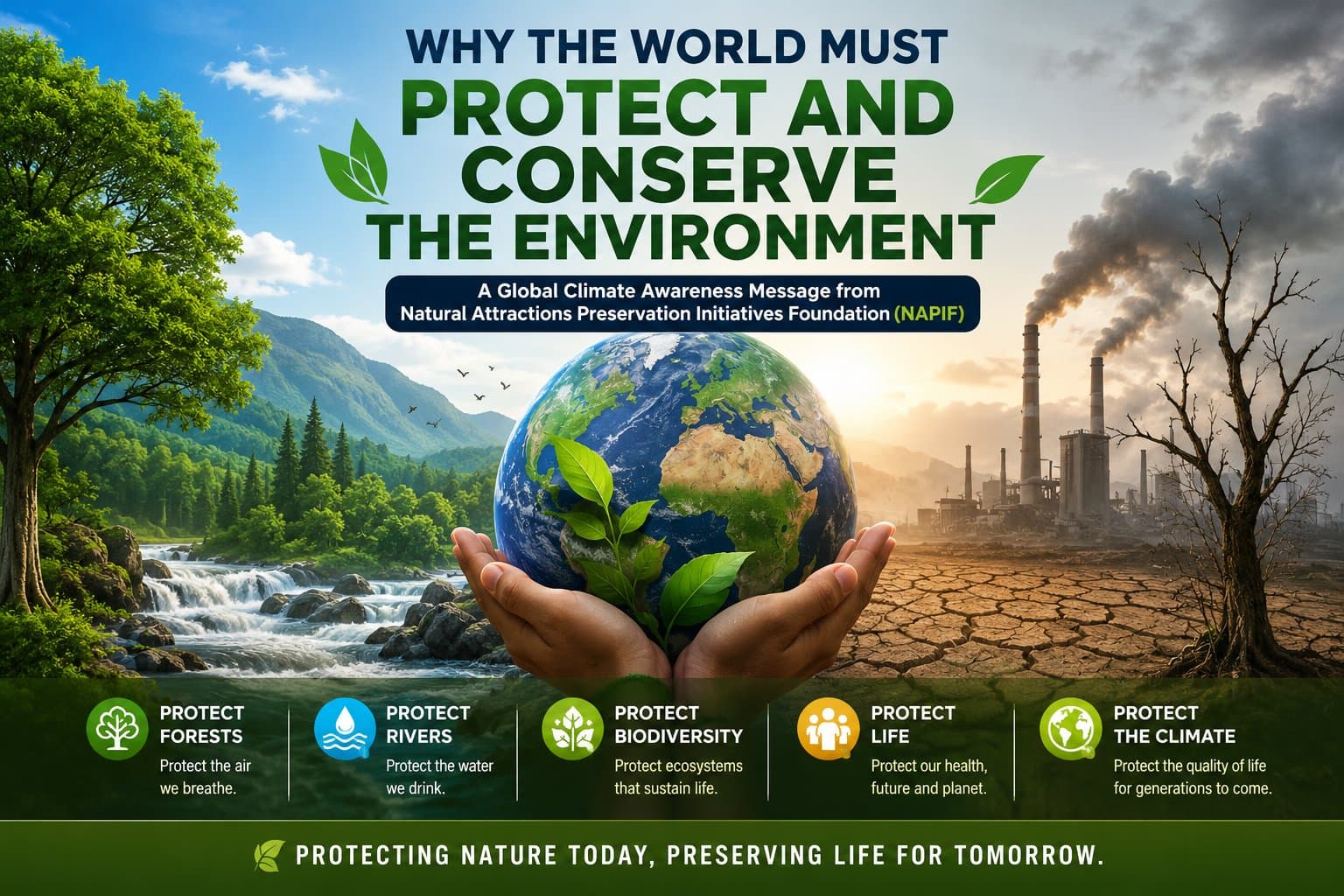
WHY THE WORLD MUST PROTECT AND CONSERVE THE ENVIRONMENT: A Global Climate Awareness Call
July 5, 2026
5 min read
Written by
NAPIF Administrator
Updated on July 9, 2026 at 1:12 PM
The environment is not simply the land we walk on, the rivers we drink from, the forests we see, or
the air we breathe. The environment is the foundation of human existence. Without a healthy
environment, there can be no healthy society, no sustainable economy, and no secure future for our
children.
Today, the world is facing environmental challenges unlike any experienced in modern history.
Climate change, deforestation, pollution, biodiversity loss, desertification, flooding, and rising
temperatures are affecting millions of people across the globe. These problems are not distant
threats; they are realities that are already impacting our communities, economies, and natural
ecosystems.
This is why the Natural Attractions Preservation Initiatives Foundation (NAPIF) is committed to
promoting environmental protection, climate education, ecosystem restoration, biodiversity
conservation, and sustainable development. Our mission is to inspire individuals, communities,
governments, institutions, and future generations to understand that protecting nature is not a
choice—it is a responsibility.
THE WORLD OF THE 19TH CENTURY: WHEN NATURE WAS STRONGER
To understand where we are today, we must first look back. During the 19th century (1800–1899),
the Earth was a very different place. The climate was generally cooler, forests were more extensive,
biodiversity was richer, and human influence on the environment was much smaller.
Most people lived close to nature. Communities depended on rainfall for farming, rivers for water,
forests for resources, and natural ecosystems for survival. Industrial activities were limited, vehicles
were few, and greenhouse gas emissions were extremely low compared to today.
The atmosphere contained approximately 280 parts per million (ppm) of carbon dioxide. The Earth
maintained a more natural climate balance, and environmental systems had greater capacity to
regulate themselves.
People understood the value of natural resources because their daily lives depended directly on
them. The relationship between humanity and nature was stronger, and environmental degradation
occurred on a much smaller scale.
THE WORLD OF TODAY: A PLANET UNDER PRESSURE
The world has experienced tremendous technological, industrial, and economic growth. While these
developments have improved many aspects of human life, they have also placed enormous
pressure on the environment.
Today we witness increasing global temperatures, more frequent heat waves, severe flooding,
stronger storms and hurricanes, droughts and desertification, rising sea levels, forest destruction,
species extinction, plastic pollution, and air and water contamination.
Human activities such as burning fossil fuels, deforestation, industrial production, and
unsustainable resource extraction have altered the natural balance of the Earth's climate system.
WHY ENVIRONMENTAL PROTECTION MATTERS
Environmental protection is not only about saving trees or protecting animals. It is about protecting
life itself.
- When we protect forests, we protect the air we breathe.
- When we protect rivers, we protect the water we drink.
- When we protect biodiversity, we protect ecosystems that support food production, medicine, and human well-being.
Environmental protection benefits human health, food security, economic growth, climate stability,
and future generations.
THE COST OF IGNORING THE ENVIRONMENT
If humanity continues to neglect environmental protection, future generations may face more
extreme weather events, food shortages, water scarcity, increased health challenges, loss of
biodiversity, economic instability, and displacement of communities due to climate-related
disasters.
THE ROLE OF INDIVIDUALS AND COMMUNITIES
Every individual can contribute by planting trees, avoiding environmental pollution, properly
managing waste, conserving water, supporting environmental initiatives, protecting wildlife and
natural habitats, promoting environmental education, and practicing sustainable lifestyles.
THE NAPIF GLOBAL MESSAGE
NAPIF believes that environmental conservation is a shared global responsibility.
COMPARING THE 19TH CENTURY WITH TODAY
COMPARING THE 19TH CENTURY WITH TODAY
During the 19th century, forests covered larger areas of the Earth, human populations were smaller,
industrial activities were limited, and pollution levels were significantly lower than they are today.
Forests played a vital role in absorbing carbon dioxide and releasing oxygen, helping to maintain a
more stable climate.
The ozone layer, which protects life on Earth from harmful ultraviolet radiation, was largely
unaffected by human activities during that period. Today, the world faces greater environmental
pressure due to rapid urbanization, deforestation, industrial emissions, pollution, and unsustainable
exploitation of natural resources.
Environmental degradation can affect human health through polluted air, contaminated water, and
extreme climatic conditions. While modern medicine has improved human survival and disease
treatment, environmental protection remains essential for public health and future sustainability.
CONCLUSION
The comparison between the 19th century and the present day clearly demonstrates how human
activities have transformed the natural environment. While development has brought many benefits,
it has also created significant environmental challenges that threaten climate stability, biodiversity,
and human well-being.
The lesson for humanity is simple: development and environmental protection must go hand in
hand.
The Earth is our shared home. Protecting it is not merely an environmental obligation—it is a moral
responsibility to present and future generations.
NAPIF FINAL MESSAGE
“The forests we protect today will provide oxygen for future generations.”
“The rivers we preserve today will provide clean water for future communities.”
“The biodiversity we conserve today will sustain life tomorrow.”
“The climate we protect today will determine the quality of life of generations to come.”
Protecting Nature Today, Preserving Life for Tomorrow.
Natural Attractions Preservation Initiatives Foundation (NAPIF)
#Environment#Nature#Climate Change